

Dispatches From The Moon: The Beginnings
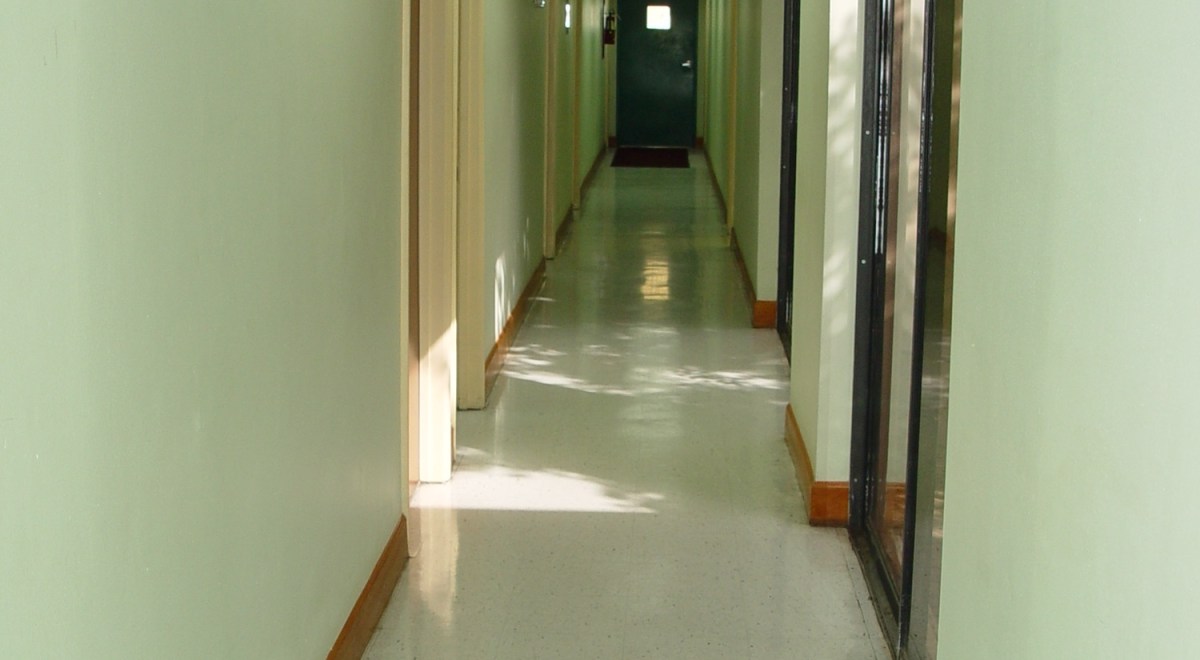
The two men are partners, lovers. One has just found out that he’s HIV+. Watching the scene of the two men walking down the hall, it could be assumed that the man who is crying uncontrollably is the one who just found out his HIV status.
Picture this: two men walking down a long, sterile, old medical building hallway. One man is weeping uncontrollably. His head is buried in the second man’s shoulder. The second man has his arms around the first man, holding him up, supporting him as they walk. His face is full of concern for the first man.
If you assumed the crying man was the HIV+ man, you’ve assumed wrong.
A few weeks before the walk down the hallway is when this story really begins: Christmas Day, 1988.
Ronn and I were celebrating our first Christmas together. There was a feeling of happiness and contentment in the air, that feeling that comes when you’re young, in love, and are close to celebrating your first anniversary. We weren’t living together yet, just spending a lot of time together.
I’d spent the morning and part of the afternoon celebrating Christmas with my mother and some family friends. I arrived at Ronn’s apartment sometime later in the afternoon. The events of the afternoon and evening are rather fuzzy. I think we exchanged gifts. I don’t know if we had planned to have dinner. All I remember was the phone call from Ronn’s sister, Theresa. It was obvious that something was wrong, and that she was ill. I could tell that much from the conversation and Ronn’s tears. There were lots of questions: how she got it (whatever it was), what the doctors thought, did dad know? There were lots of tears. Even if you’d asked me that day how long the phone call lasted, I’m not sure I could have given an accurate answer. To me, it seemed to go on forever. Hearing only half of that type of conversation leaves you feeling helpless and frustrated. I had no idea what was wrong, only that something serious seemed to be going on. Cancer, it seemed to me, was probably what it was. But what kind?
When Ronn hung up, the tears flowed even more, the tears of deep anguish: not the tears that just fall from one’s eyes, rather, the tears that start out deep in the soul, and push their way through the heart, then out the eyes. He couldn’t speak for a very long time. He’d been sitting on his bed while he was on the phone. I climbed onto the bed, and we lay down, my arms around him, his head on my chest, and he trembled and cried. For nearly two hours we lay there; his sobs and gulps for air were the only sounds. I didn’t press him for details, I knew he’d tell me when he was ready. Crying was what was most important.
When he finally spoke, the words he said were not anything like I was expecting to hear.
“Theresa has AIDS.”
I think the words were shocking not only for their unexpectedness, but, for what they represented: the intrusion of AIDS in our lives. In those early years of AIDS, it was a disease of New York, a disease of San Francisco. No one around us had it, so it allowed us to live in our little shelter, with it’s cardboard walls.
“Theresa has AIDS.”
The storm winds just blew the cardboard walls away. One probably always remembers the particulars of what they were doing when bad news is received, but, in those early days of the plague, the first time you heard that someone had It, you remember not just because the news is bad, you remember the moment because it became the moment when you could no longer pretend that AIDS was something that happened to other people, that it could finally crumble the walls of denial you’d surrounded yourself with its trumpet blast.
The next few days were spent in an emotional vacuum. Theresa didn’t feel she could tell her family about her diagnosis, and had asked Ronn to share the news. He spent a good deal of time on long-distance calls in those first few days. Each call was emotionally draining for him, and I spent a good deal of time doing what I did on Christmas Day: holding him, and letting him cry. I was frustrated and angry that there was so little I could do. I hated seeing him in that much pain. I was deeply saddened by the news, but, at the same time, I wasn’t as devastated as he was. For me, his sister was this rather nebulous person — someone I knew of, but had never met; the rest of his family were just as vague to me, since they lived two thousand miles away, and I had never met them.
About two weeks after Ronn’s sister called with her news, Ronn said that he thought that we should both get an HIV test. We arranged our schedules so we could go together. We decided to go to the City Health Clinic to get tested. We could have each gone to our primary care doctor, but, back in the day, there were lots of doctors who were dropping patients who had HIV. We figured it would be easier to get tested through the clinic, and, it would give us time to find a doctor who treated HIV+/AIDS patients if we needed to, rather than just be dropped by our current doctors, something that seemed humiliating if it were to happen.
From the moment we arrived in the clinic, I knew that my test would come back positive for the virus. An argument could be made that my certainty was just a defensive mechanism, that it was my mind preparing for the worst-case scenario. In this case, though, I’m not convinced by that argument. I’ve had that experience, before and since, of expecting the worst. In my case, when this happens, this feeling of dread is quite emotionally charged: I worry, I play scenarios over and over in my mind, I don’t sleep well, I am nervous and jittery, I’m even more neurotic that usual.
This was different.
Three things happened practically simultaneously: the nervous-anticipation I always felt when I knew I was going to have my blood taken vanished, to be replaced with a sense of calm acceptance; a voice said “I’m HIV+”, though I hesitate to use the word voice, as it sounds schizophrenic, so I’ll call it a sound, a sound that seemed to be pushed up from my chest to my brain, and the sound made a noise that seemed to say “I’m HIV+”.
An image flashed before me, a specific image, a brief glimpse of a sexual encounter I’d had a few months before I’d met Ronn. I don’t know why that particular image appeared in my mind — it certainly wasn’t the only sexual encounter I’d had before I met Ronn. There was nothing about the man I was having the encounter with that suggested that he might be infected, there was no sudden realization that a spot on some part of his body was an AIDS spot; as far as I can remember, there were no marks of any kind on his body. The vision that appeared was so sharp, so clear, and so real, that even now, thirty-eight years later, I can still see and feel the image in my mind. I’m not much of a believer in psychic phenomena — though, I’m not so close-minded that I don’t believe that some things can’t be explained scientifically — but, those first moments, when I walked into the clinic left me convinced that my test was going to come back positive. Whether it was my body telling me, or whether it was my brain just bracing itself for the worst, I’ll never know for sure. What I do know is that the calm that came over me stayed with me for the two intervening weeks, while we waited for our test results. Ronn was, understandably, very nervous about it.
We arrived for our test results appointment, and after a short wait in the waiting room, we were escorted into a small room, and offered seats in one of several school desks at the front of the room. Some writers might remark on the appearance of the room, commenting that the bright, colorful room contrasted with the grim news they received, or that the starkness of the room was foreboding, a glimpse of the results to come. Some writers are more observant than I (or is it ‘than me?) Quite frankly, other than the fact that we sat in two desks, and the nurse sat in a desk facing us, I could tell you nothing about the room; if it offered any glimpse of what was to come, I was oblivious.
I’m not going to badmouth the nurse who gave us our results, because I’m sure that there’s really no good way to tell people that their life has just changed dramatically. The fact that he didn’t group us together with a phrase like “both of your tests came back negative” was my first confirmation. He looked at Ronn, and said “Ronn, your test has come back negative. You’re not infected.” There was a long silence, and finally he looked at me, and spoke the words I’d known I’d hear, “John, I’m sorry, but your test came back positive. You are infected with HIV.”
There was a loud gasp, and an even louder, uncontrolled sob, and, so unexpected the sob, that I thought, for the briefest of moments, that it came from me. Then, I realized that it was Ronn. He sat there, slumped over, his hands covering his face, sobbing, his chest heaving. Because we were seated in desks, there wasn’t much I could do but reach over and hold onto his arm, squeezing it in reassurance.
The nurse sat quietly for a minute or two, and asked me “Are you doing okay?” I nodded. “Do you have any questions?” I shook my head. I just wanted to leave. I wanted to get Ronn out of there.
We sat there for a few more minutes, the only sound was Ronn’s sobbing. Finally the nurse, looking directly at me, said “Are you sure you’re okay? We’ve got counselors here if you’d like to talk to someone. I know it’s tough to come to grips with, and we’d like to be sure that you’re doing okay before you leave.”
I couldn’t help it. The words just came out. “Why are you asking me if I’m okay? Don’t I look okay? Don’t you think you should be worried about the one of us who doesn’t look like they’re doing ok? Do you have counseling for him?”
“I’m sorry. We don’t have any counselors here for the partners of HIV+ people. I can give you a list of support groups and therapists who would be willing to talk to Ronn.”
“What the fuck good are you then, if you’re not able to help those who need it?”
“I’m sorry. We don’t usually… Maybe I can go see if one of the …”
“Forget it.” I stood up. I walked around my desk, and knelt down beside Ronn. “Let’s go,” I said, softly, “Let’s get you home.” I helped him out of the chair. He was crying so much that he could barely keep himself upright. He leaned himself against me. I put my arms around him, and, together, we made our way down the hall, to the car, and, finally, home.
 John Francis Nooney